Background
 The human body consists of approximately 5 liters of blood. Blood is made up of 2 components: blood cells and plasma. There are three type of blood cells present:
- Red Blood Cells
- White Blood Cells
- Platelets
Red blood cells contain a substance called hemoglobin. Hemoglobin binds to oxygen and transports it throughout the body. Thus, it is essential for life. Every individual inherits genes from each parent; one gene comes from the mother and one from the father. Adult hemoglobin is made up of 2 alpha and 2 beta chains. The synthesis of these chains is under the control of alpha & beta genes, which are inherited from parents.
What is Thalassaemia?
Thalassemias are a group of inherited blood disorders characterized by decreased or absent production of hemoglobin chains. The two main types of thalassaemias are called “alpha” and “beta,” depending upon decreased production of alpha or beta chains.
- Alpha Thalassaemia – Decreased / absent production of alpha globin chains (due to defective α genes)
- Beta Thalassaemia – Decreased / absent production of Beta globin chains (due to mutation or change in β genes)
Epidemiology
Thalassaemias are prevalent in populations of Mediterranean, Middle East, Indo Pakistan, and Central & South East Asia. They are also common in African countries. Every year 100,000 children are born with thalassaemia major. About 80-90 million people are carriers of βeta Thalassaemia and constitute 1.5 % of world’s population.
Carrier frequency is 5.4% and there are approximately 13.2 million carriers in Pakistan. About 6,000 affected children are born per year with a frequency of 17 children per day. There are 60,000 registered patients in Pakistan. High number of carriers and increased incidence of consanguineous marriages (60 % first cousin, 15% second cousin, 15% inter biradari) are the main reason for the high birth rate of Thalassaemia Major children.
βeta Thalassaemia
βeta Thalassaemia is an autosomal recessive genetic disorder. It is the most common single gene disorder. There are three types:
- Asymptomatic βeta Thalasssemia Minor (Carrier)
- βeta Thalassaemia Intermedia (which presents as moderate anemia requiring intermittent transfusions)
- βeta Thalassemia Major (which presents as severe anemia requiring lifelong transfusions and iron chelation therapy)
Inheritance of Genetic Disorders
Inheritance is a process by which genetic information is passed on from one generation to next generation. The members of the same family tend to have similar characteristics. The gene is the basic physical unit of inheritance. Genes are passed from parents to offspring and contain the information needed to specify traits. Different modes of inheritance exist for single gene disorders: autosomal dominant, autosomal recessive, X-linked recessive and X-linked dominant. Dominant mutation requires one defected gene for the condition to develop, whereas recessive mutations requires two defected genes for the disease to be manifested. Recessive genetic diseases are not typically seen in every generation of the family as compared to dominant mutations which present in every generation.
Thalassaemia and Inheritance
Thalassemia is inherited in autosomal recessive pattern meaning both the genes have to be mutated or defective for the person to exhibit the symptoms of the disease. An individual is said to have the trait or thalassemia minor or is called a carrier, if he/she inherits one healthy gene from one parent and a second mutated (defective) gene from the other parent. Carriers are absolutely healthy individuals but they can transfer the abnormal gene to their children. When genes inherited from both parents are defective, the person is said to have the disease i.e. thalassemia major/thalassemia intermedia and requires lifelong treatment.
If 2 carriers marry each other, then there is 25% chance of having a child with thalassaemia major, 25% chance of having a normal child and 50% chance of having a carrier child in each pregnancy.
 |
 |
A person who is screened for thalassaemia and is found to be a carrier or is said to have the thalassaemia trait; should this individual choose to marry a non-carrier person, then this couple has a 50% chance of having a normal child, 50% chance of having a carrier child and zero chances of having a Thalassaemia Major Child during each pregnancy.
Therefore, it is absolutely necessary to screen populations to identify at risk individuals who can then be counselled and equipped with adequate knowledge. This information will help them in making decisions regarding marriages and preventing genetic disorders in future generations.
βeta Thalassaemia Major
In βeta Thalassaemia Major, no or very less amount of beta chains of hemoglobin is formed due to mutation in beta globin genes. Thus, severe anemia occurs; a condition characterized by decreased hemoglobin in the blood leading to an inability to adequately transport oxygen throughout the body. Clinical presentation of βeta Thalassaemia Major occurs between 6 - 24 months after birth. Common symptoms and signs include:
- Failure to Thrive
- Pallor
- Feeding Problems
- Diarrhea
- Irritability
- Facial Bones Deformities
- Abdominal Swelling
- Dark Urine
Treatment
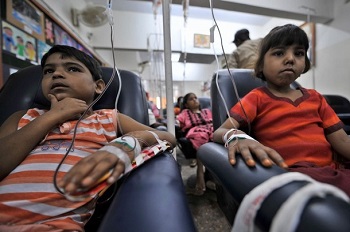
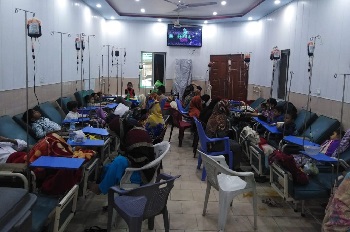
The main treatment is regular blood transfusions which corrects anemia. Unfortunately, patients receiving regular transfusions eventually develop various complications mainly due to iron overload. Iron chelation is the mainstay of treatment for excessive iron in the body.
 |
 |